The English Words With the Most Meanings (Break Has 75)
The word with the most meanings in our list is break, with 75 separate senses in WordNet, from breaking a glass to a lucky break to breaking the news. Cut has 70 and run 57. They are all short, old and extremely common, and that is no coincidence.
Key facts
- Break: 75 meanings. Cut: 70. Run: 57. Play: 52. Make: 51.
- Easy words average 7.0 meanings each; hard words average 2.0.
- Only 8.9% of easy words have a single meaning, compared with 48% of hard words.
- 19 of the top 20 are one-syllable words.
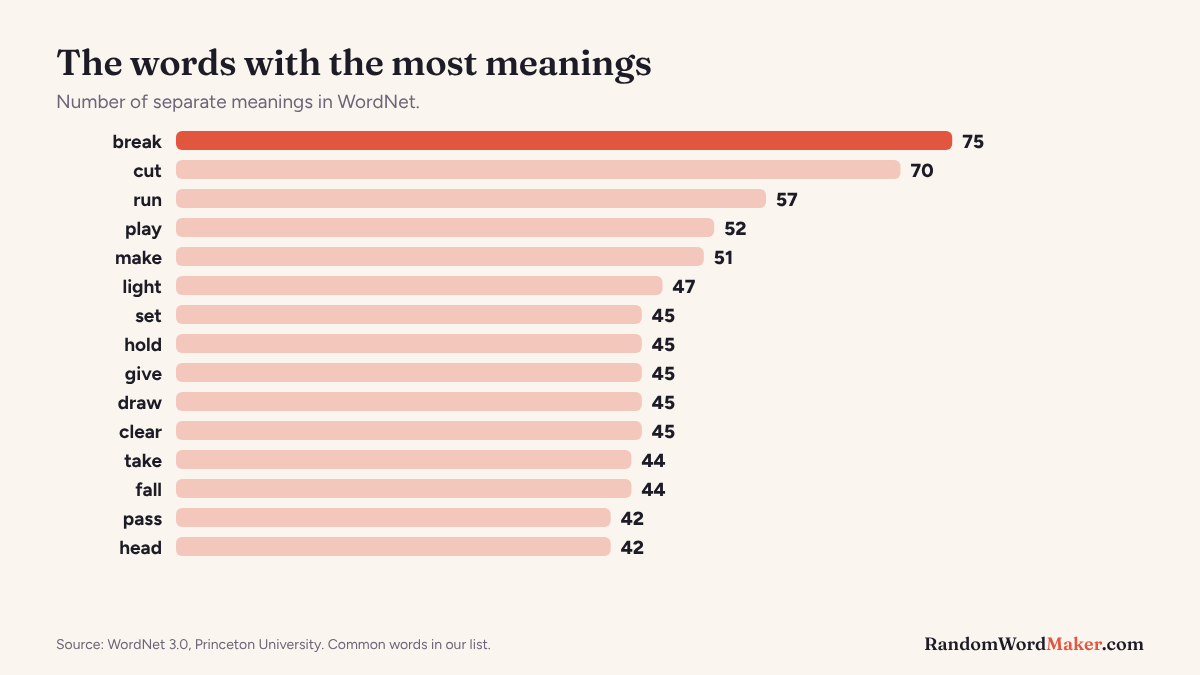
The top 20
| Word | Meanings | Word | Meanings |
|---|---|---|---|
| break | 75 | take | 44 |
| cut | 70 | fall | 44 |
| run | 57 | pass | 42 |
| play | 52 | head | 42 |
| make | 51 | carry | 41 |
| light | 47 | call | 41 |
| set | 45 | point | 40 |
| hold | 45 | charge | 40 |
| give | 45 | catch | 39 |
| draw | 45 | clear | 45 |
WordNet counts each meaning separately for each word type, so “break” includes its meanings as a verb (“break the vase”) and as a noun (“a short break”).
Why common words collect meanings
Linguists call this polysemy. A word that is used a lot gets stretched to new situations, and the new uses stick: you can run a race, run a company, run a program and have a run of bad luck. Rare words have not had that pressure. A word like sturgeon just means one kind of fish.
| Level | Average meanings | Words with only one meaning |
|---|---|---|
| Easy | 7.0 | 8.9% |
| Medium | 3.2 | 25.3% |
| Hard | 2.0 | 48.0% |
A tip for learners and teachers
The easiest-looking words are often the hardest to master, because learners have to meet each meaning in context. When you generate words for a lesson, open more meanings on each card: a quick round of “use it two different ways” works well with words like light, draw or charge.
Sources
- Our own count of WordNet senses for each word. WordNet 3.0, Princeton University.