How to Use Random Words as Writing Prompts: 7 Methods That Work
A blank page is hard; a blank page with three strange words on it is a puzzle, and puzzles are easier to start. Random words force your brain to make connections it would not make on its own, which is exactly what you want when you are stuck.
Key facts
- Random words work because they create unexpected constraints.
- Start with three nouns for short pieces and five mixed words for longer ones.
- Meanings on each card help when a word is unfamiliar.
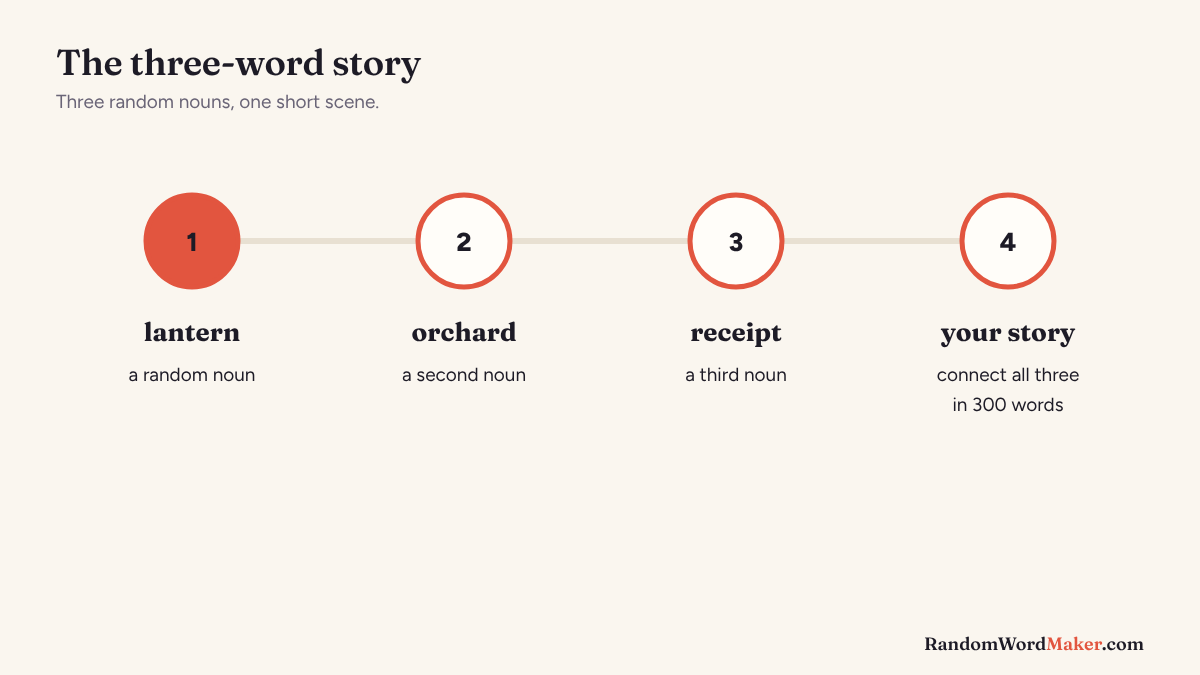
1. The three-word story
Generate three nouns with the noun generator. Write a short scene that uses all three. For example, lantern, orchard, receipt might become a night-time search for a lost receipt in an orchard.
2. Title first
Use the word combination generator to make an adjective-noun pair like Silent Harbour or Paper Comet. Treat it as the title and write the story that deserves it.
3. Build a character
Generate one job, one emotion and one object. That is your character: a nervous lighthouse keeper who never goes anywhere without a compass. Ask what they want and what is in their way.
4. Set the scene
Generate a place and two nature words. Describe the place in exactly 100 words using both.
5. Swap the verb
Write a plain sentence, then replace its verb with a random one from the verb generator. “She opened the door” becomes “She persuaded the door”. Unusual verbs can suggest a whole new voice.
6. The one-syllable poem
Set syllables to 1 and generate 20 words. Write a short poem using only one-syllable words. The limit makes lines punchy and direct.
7. Daily warm-up
Use the word of the day as a five-minute free-writing prompt each morning. Keep going without stopping or editing.
Keeping it useful
- Do not reject a word because it seems wrong. The awkward ones lead to the best ideas.
- Tap ★ to keep words that spark something, then copy your kept list into your notes.
- If a word is unfamiliar, read its meaning on the card. You may learn a word and get a story out of it.
Sources
- Methods compiled by the RandomWordMaker team from common creative-writing practice.